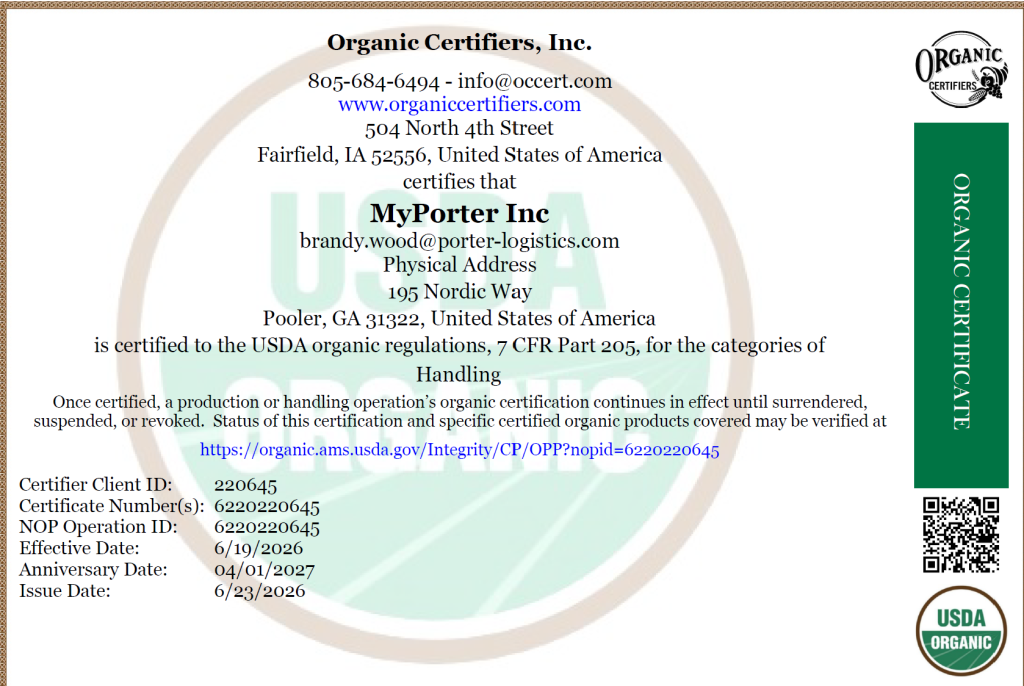
Porter Logistics today announced that its Savannah-area facility on Nordic Way has achieved USDA National Organic Program (NOP) certification as an organic handler, certified by Organic Certifiers under 7 CFR Part 205. The certification clears our Savannah food grade operation to receive, store, repackage, and ship certified organic products while preserving their organic status through every step of the supply chain.
For a facility already built around chemical and food-grade handling, temperature control, and bonded warehousing, organic certification is a natural extension — and one that meaningfully expands what we can offer the brands and manufacturers moving product through the Port of Savannah.
Organic certification is often misunderstood as a label or a marketing claim. It is neither. It is a federal compliance program with real teeth, and the bar for a handling operation like ours is substantial.
Under USDA rules, any operation that handles organic product — opening containers, repackaging, re-drumming, filling totes or IBCs, relabeling, or otherwise processing it — must be certified. Only a narrow exemption exists for facilities that receive sealed, tamper-evident packages and ship them back out without ever opening them. Because our value to customers lies in exactly the kind of value-added handling that falls outside that exemption, certification wasn’t optional for us — it was the price of entry into organic supply chains.
Achieving it meant building and validating a program that includes:
An Organic System Plan (OSP) — a written playbook, agreed to with our certifying agent, that documents every point at which organic product is received, stored, handled, and shipped, and how organic integrity is protected at each one.
Commingling prevention — physical separation of organic and conventional product through dedicated storage zones, clear labeling, and documented procedures. If organic product mixes with conventional, the organic status is gone.
Prohibited-substance controls — every cleaning agent, sanitizer, and pest-management material that touches or shares space with organic product must be verified against approved standards.
Traceability and recordkeeping — a complete audit trail that traces product back through the supply chain to the last certified operation, with lot-level records available for inspection at any time.
Annual third-party inspection — a USDA-accredited inspector reviews our facility, records, and procedures every year. Under the current rules, these audits can be unannounced.
This wasn’t a one-time certificate. It’s an ongoing commitment to a documented, audited standard — and the reason a customer can trust that product leaving our dock is still exactly as organic as the product that arrived.
The stakes around organic handling rose sharply in March 2024, when the USDA’s Strengthening Organic Enforcement (SOE) rule reached full implementation. Described as the most significant change to the national organic regulations since the program’s creation, SOE closed longstanding loopholes and pulled a much broader set of operations — brokers, traders, importers, distributors, and warehouses — into the certification requirement. It also tightened traceback obligations and expanded the use of unannounced inspections.
The practical effect for brand owners is simple: your organic product is only as compliant as the least-compliant link in your chain. If an uncertified facility opens or repackages organic product, that product loses its organic status and can no longer be sold or labeled as organic — with civil penalties that can reach roughly $11,000 per violation for misrepresentation.
That reality is precisely why organic certification has become a genuine differentiator in the 3PL market. Many warehouses have not made the investment, because the compliance, documentation, and infrastructure demands are real. For the brands we serve, working with a certified partner removes a major point of risk from their supply chain — they don’t have to carry the cost, delay, and audit exposure of certifying every touchpoint themselves, and they can demonstrate a clean chain of custody if questioned.
Certification unlocks a category of work our Savannah facility couldn’t previously take on, and it stacks well with capabilities we already have in place on Nordic Way:
We can now perform value-added organic handling — repackaging, re-drumming, tote and IBC filling, and relabeling — on certified organic ingredients and finished goods without breaking the organic chain. This is where certification pays off most directly, because it’s the handling most 3PLs can’t legally do.
We can pair organic handling with our multi-temperature environments — heated, conditioned, refrigerated, and frozen. Many organic products are temperature-sensitive, and the SOE rule has raised the bar on documentation, making the kind of monitored, records-driven cold and conditioned storage we operate an even better fit for organic food.
We can support organic imports through the Port of Savannah, one of the busiest container gateways in the country. Commercial organic imports require an intact certified chain from the port forward, and a certified handler positioned this close to the terminals is well placed to serve importers and brand owners bringing organic product into the U.S. Southeast. Our bonded warehousing further extends what we can offer around imported and in-transit product.
And because our certification sits alongside our existing GMP certification and food-grade handling practices, customers get organic compliance layered onto a facility already built for regulatory rigor — not a bolt-on.
“Earning organic certification at our Savannah facility reflects the standard we hold ourselves to across everything we handle,” said John Foshee, Founder and President of Porter Logistics. “Our customers are moving more organic product through the Southeast every year, and they need partners who can handle it correctly — with the documentation, segregation, and traceability the rules now demand. We built this program so brands don’t have to choose between value-added handling and organic integrity. They can have both, right here in Pooler.”
Brands and manufacturers interested in certified organic warehousing and handling at our Savannah facility can reach out to our team to discuss capabilities, capacity, and onboarding. Our certification status can be verified through the USDA Organic INTEGRITY Database at https://organic.ams.usda.gov/Integrity/CP/OPP?nopid=6220220645
Porter Logistics is a chemical- and food-focused third-party logistics provider with facilities in Atlanta and the Savannah area. Our capabilities include multi-temperature storage (heated, conditioned, refrigerated, and frozen), chemical repackaging and re-drumming, tote and IBC filling, bonded warehousing, GMP-certified handling, DOT hazmat handling, and flammable-storage environments. From our Nordic Way facility in Pooler, we serve manufacturers and brand owners moving product through the Port of Savannah and across the Southeast.