Picture a Tuesday morning. Your biggest supplier emails: the plant is down for three weeks. You check your stock. Nine days. Now who do you call, and what do you tell your customers?
Anyone who’s worked in logistics has lived some version of that. The teams that handle it well aren’t lucky. They found the weak spot before it broke. And the teams that don’t? They usually knew about it too. They just never had the time.
The wider picture isn’t calm either. The New York Fed’s supply chain pressure index rose to 1.28 in September, up from a revised 1.20 in August. It hit its highest level since 2022 in April, when the U.S.-Iran conflict disrupted trade through the Strait of Hormuz, PYMNTS reports.
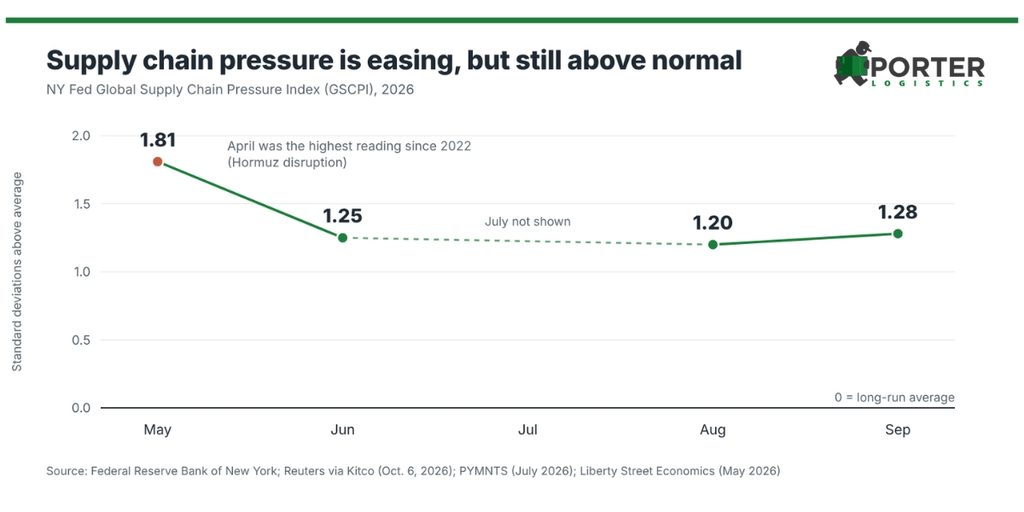
Pressure is down from the spring. It isn’t gone. And here’s the part that should bother you: in the RELEX 2026 State of the Supply Chain survey, 86% of leaders said trade policy or tariffs had already hit their operations. Only 18% restructured their supply chains or delayed investments. Most companies are patching, not strengthening.
Strengthening isn’t adding buffer everywhere. That’s expensive, and it still misses the thing that breaks. It’s finding the one or two places where your chain can actually fail, and paying to fix those first. We’ll walk through how, with the math. We’re a 3PL, so we have a stake, and we’ll say where a warehouse helps and where it doesn’t.
The cost examples below use made-up numbers to show the method. Swap in your own before making decisions.
You know your suppliers. You’ve got their numbers, you’ve met their reps. But do you know theirs?
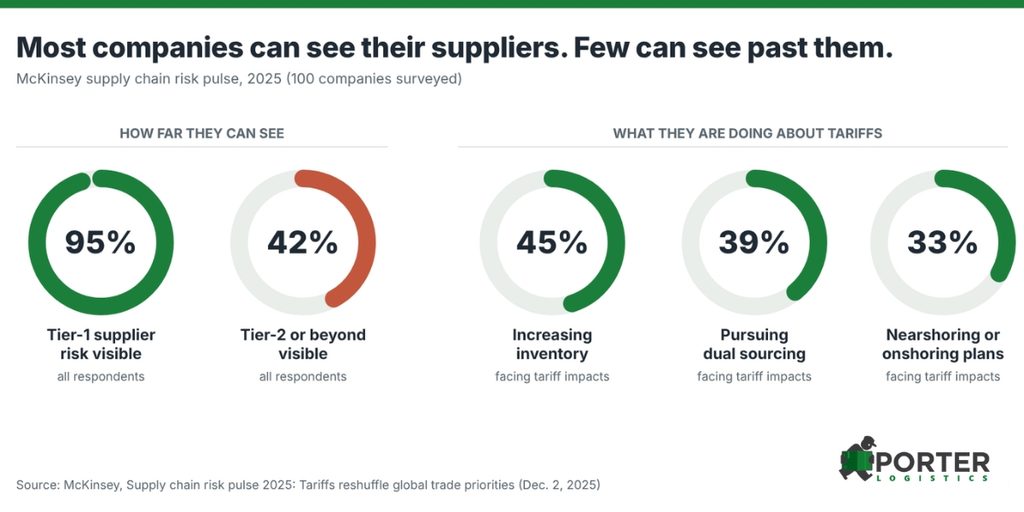
McKinsey’s 2025 survey found 95% of companies have visibility into their tier-one suppliers’ risks. Only 42% see tier two or beyond. That’s where the surprises live: the resin plant your supplier depends on, or the single port its parts all move through.
Start with a plain list. No software, no consultant. Take your top SKUs and score each on three things: how much revenue rides on it, how long the lead time is, and how hard it would be to replace. The items that score high on all three, and have one supplier, are your weak links. Most companies find a handful, not a hundred. It’s a little uncomfortable to see them written down. Good. Fix those first.
“Add a second supplier” is the standard advice. It’s right, but it has a price, and sometimes the price is higher than the risk. It also feels a bit disloyal. Nobody enjoys making that first call to a supplier they might never use.
Say you spend $2 million a year with one supplier. A second supplier would take 30% of the volume but charge 8% more. That premium costs about $48,000 a year. Now the other side. Suppose there’s a 10% chance a year that your single supplier goes down for eight weeks, and you lose $75,000 of margin each week. The expected loss is 10% of $600,000, or $60,000.
$48,000 against $60,000. It’s close. That’s the point.
You can’t know the probability. You can calculate the impact: weekly margin times the weeks it takes to qualify a replacement. So spend your effort there. If a part’s impact is huge, dual sourcing pays almost whatever the odds. If it’s small, skip it.
Three things make dual sourcing fail in practice:
Nearshoring is the bigger version of this bet. In McKinsey’s survey, 33% of companies facing tariff impacts were developing nearshoring or onshoring plans, and only 12% said tariffs were the sole reason. It shortens lead times, but it doesn’t remove risk. It swaps one set of risks for another, so run the same math.
In the RELEX survey, 28% of leaders raised safety stock. Another 27% went leaner. Both camps can be right, and the reason is a number most buffer plans ignore.
The standard safety stock formula is z × √(L × σd² + d² × σL²). In plain terms, you need buffer for two things: demand that varies, and lead times that vary. Here’s a worked example. Demand averages 100 units a day, with a standard deviation of 20. Lead time averages 30 days, with a standard deviation of 10. For a 95% service level, z is 1.65.
| Scenario | Safety stock needed |
|---|---|
| Demand varies, lead time is perfectly reliable | about 180 units |
| Demand varies, lead time varies by 10 days | about 1,660 units |
| Demand varies, lead time varies by 5 days | about 845 units |
Lead-time variability is what costs you. It’s nine times the buffer in this example. Cut that variability in half and the buffer nearly halves too. If you’ve ever doubled your safety stock and still run out, this is probably why.
That changes the order of operations. Before you pay to store more, ask whether you can make lead times more reliable: better carriers, earlier booking, a closer node. Reliable beats fast, and it’s cheaper than a bigger building. Space isn’t free either. CBRE puts average asking rent in Savannah at $7.32 per square foot, up 4.4% on the year, and expects availability to tighten.
When you do need buffer, you don’t always need to sign a long lease for it. Our inventory overflow approach, covered in more detail on our Savannah overflow service page, is built for temporary surges. Whether public or contract warehousing fits depends on how steady your volume is.
Everybody has a backup port on paper. Few have ever sent a pallet through it.
Imagine your usual gateway shuts for four days. The backup lives in a spreadsheet. Your broker has never filed an entry there, your trucker doesn’t know the terminal, and the first quote is a number you’ve never seen. That isn’t a plan. It’s a hope with a tab in Excel.
In 2024, the threat of a dockworkers’ strike on the East and Gulf Coasts put roughly 43% of U.S. imports at risk, as we wrote in our post at the time. In 2026 it was Hormuz, and we looked at what that did to chemical sourcing in our Iran war post. Different shocks, same lesson. A route is only a plan once you’ve used it.
So pick one lower-priority shipment a quarter and run it through the alternate gateway or carrier. Yes, it’ll cost slightly more. You’ll learn what the paperwork, the drayage and the timing really look like while nothing is on fire. The first time shouldn’t be during a crisis.
Tariffs are a cash-flow problem as much as a cost problem. A customs bonded warehouse lets you hold imported goods without paying duty until you withdraw them for U.S. consumption, and re-exported goods may avoid it entirely. Our bonded warehouse tariff strategy post covers how it works.
It isn’t right for everyone. Bonded storage means a bond, strict records and extra paperwork. If your goods clear and sell within days, plain warehousing is simpler. A foreign trade zone is another route, and we compared the two in bonded warehouse vs. FTZ.
In the RELEX survey, 59% of leaders strengthened their logistics partnerships. Makes sense. A good 3PL adds flexible space, gateway options, customs know-how and live inventory data you may not have in-house. If you’re still weighing it, 3PL vs. in-house logistics breaks down the trade-offs.
Here’s what a 3PL can’t fix. It can’t fix a single-source supplier or a tier-two problem you haven’t mapped. It sits downstream of those. Be wary of anyone who says otherwise, us included.
For the record, Porter runs a 230,400 sq ft facility in Pooler, GA, about seven miles from Garden City Terminal, with customs bonded, food-grade, hazmat and temperature-controlled storage. Customers get a WMS and dashboard at no extra charge, with integrations through our technology platform. See our Savannah location. If you’re in chemicals specifically, start with how to strengthen your chemical supply chain strategy.
None of this is glamorous. Nobody throws a party for the shock that didn’t hurt. But that’s the whole job: be the team that already knew where it would break, and already had a plan when it did.